

Chelsea's Wasp Rickman Metisse
By Ross Sharp - 05 Mar 19

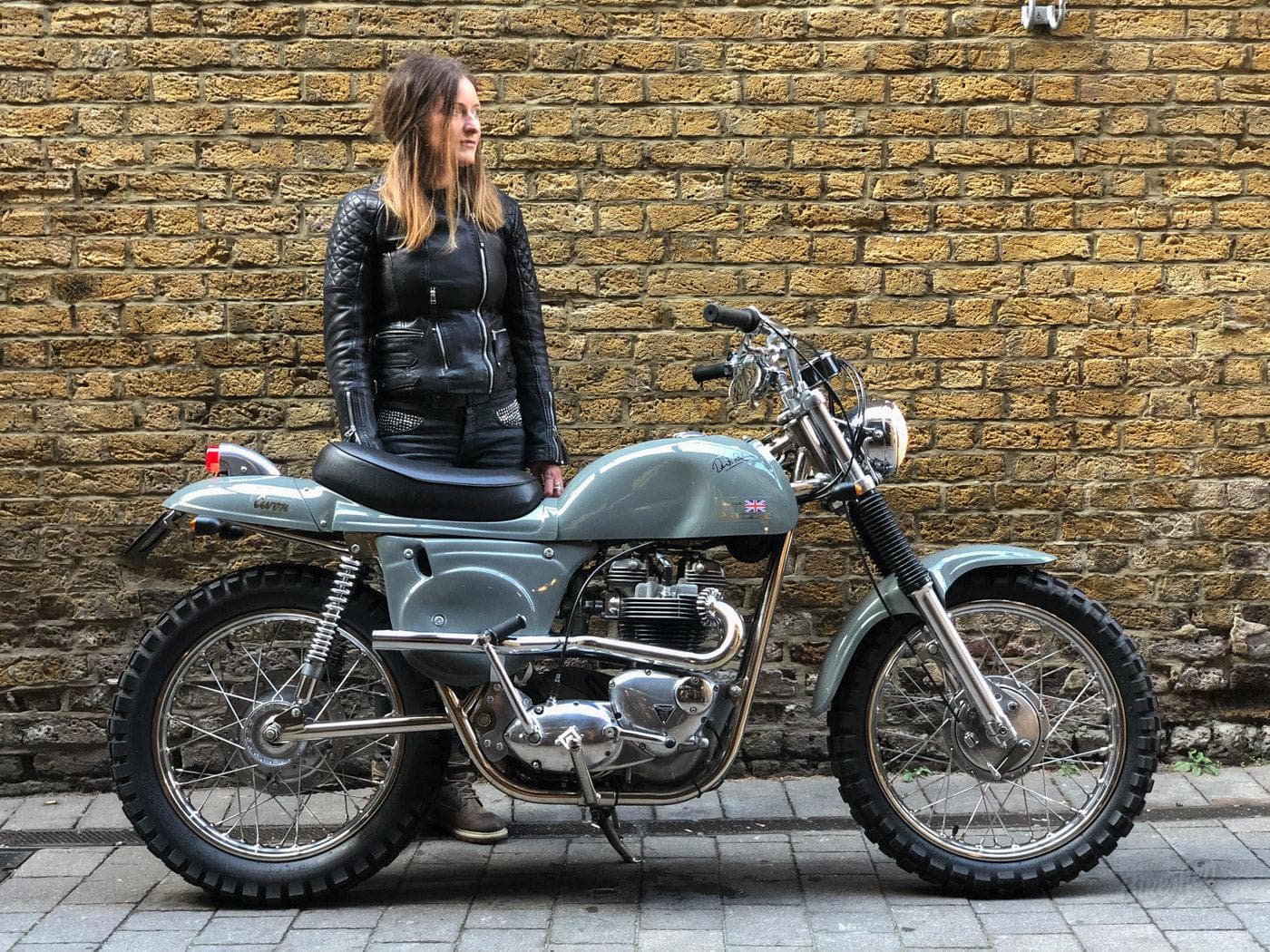 Chelsea Borchert is one of my new favourite people. Her effervescent enthusiasm for building bikes and riding the fruits of her labour is infectious, reminding me of a time when my passion for projects was impervious and the rigors of trying to maintain a fleet of two wheelers had yet to take its toll. I caught wind of her Rickman Metisse adventures while working on a new race bike folly with traditional frame builders Wasp Motorcycles and I've have been following her progress on the Instagram ever since. Her giddy excitement is palpable and a helpful reminder to crack on and get stuff finished.
The bike she's built is stunning. I've seen a few of these replicas over the years (my mate Tim shows off his one in his living room) so there's nothing new in terms of style but when something looks as right as this, there's no need to mess with it. Chelsea has demonstrated that she's not only eminently practical and a sponge for learning the art of traditional crafts but is also meticulous in her approach. Little wonder, she's inherited an engineer's mindset from her architect and vintage plane building father.
We had this very bike on display here at the Bike Shed for a couple of weeks and the fit and finish would put some seasoned pros to shame. Anyway, enough of my gushing, read Chelsea's story for yourself, in her words. Enjoy.
Chelsea Borchert is one of my new favourite people. Her effervescent enthusiasm for building bikes and riding the fruits of her labour is infectious, reminding me of a time when my passion for projects was impervious and the rigors of trying to maintain a fleet of two wheelers had yet to take its toll. I caught wind of her Rickman Metisse adventures while working on a new race bike folly with traditional frame builders Wasp Motorcycles and I've have been following her progress on the Instagram ever since. Her giddy excitement is palpable and a helpful reminder to crack on and get stuff finished.
The bike she's built is stunning. I've seen a few of these replicas over the years (my mate Tim shows off his one in his living room) so there's nothing new in terms of style but when something looks as right as this, there's no need to mess with it. Chelsea has demonstrated that she's not only eminently practical and a sponge for learning the art of traditional crafts but is also meticulous in her approach. Little wonder, she's inherited an engineer's mindset from her architect and vintage plane building father.
We had this very bike on display here at the Bike Shed for a couple of weeks and the fit and finish would put some seasoned pros to shame. Anyway, enough of my gushing, read Chelsea's story for yourself, in her words. Enjoy.
 Many people have asked me ‘Why a Rickman?’ You only have to look at it to understand!
I fell totally in love with the Rickman Metisse when my Dad came home from display flying at an airshow; he had randomly bought a Metisse over the weekend. I later learned all about it and ultimately understood why he snapped it up. I’ve always loved classic bikes (especially scramblers) and this was the ultimate historic scrambler. It turned out to be a 1962 Petite Metisse with a Triumph 500cc engine. I went with him to collect it the following weekend and was instantly bombing around the airfield at Bicester Heritage - no helmet, strappy top and sunglasses. I had never felt anything like it - It was a very empowering and a lovely handling bike to ride.
Over the next year I rode it on road and off road - it became my dream bike. At the time I had a yellow 1977 Honda CB 400 Super Four which I loved riding at every opportunity, but nothing beat the sound, the look and the lightness of my Dad’s Rickman. After a breakup, I decided to sell my Honda - a sort of spur of the moment decision, thinking let’s just see what it goes for. My Honda sold in a week for £2,500 more than what I paid for it, which inspired me.
Many people have asked me ‘Why a Rickman?’ You only have to look at it to understand!
I fell totally in love with the Rickman Metisse when my Dad came home from display flying at an airshow; he had randomly bought a Metisse over the weekend. I later learned all about it and ultimately understood why he snapped it up. I’ve always loved classic bikes (especially scramblers) and this was the ultimate historic scrambler. It turned out to be a 1962 Petite Metisse with a Triumph 500cc engine. I went with him to collect it the following weekend and was instantly bombing around the airfield at Bicester Heritage - no helmet, strappy top and sunglasses. I had never felt anything like it - It was a very empowering and a lovely handling bike to ride.
Over the next year I rode it on road and off road - it became my dream bike. At the time I had a yellow 1977 Honda CB 400 Super Four which I loved riding at every opportunity, but nothing beat the sound, the look and the lightness of my Dad’s Rickman. After a breakup, I decided to sell my Honda - a sort of spur of the moment decision, thinking let’s just see what it goes for. My Honda sold in a week for £2,500 more than what I paid for it, which inspired me.
 However, the hunt for a suitable replacement was proving hard, with time ticking away and the summer was nearly over. The Honda was heavy but reliable and cruised at a nice speed - and like the Metisse, it was a good looking, fun classic. Nothing else I tested compared. Although I was having fun riding my Dad’s Metisse, I needed my own bike.
Dad needed a new fuel tank for his Metisse and we got to know Wasp Motorcycles, who specialise in producing classic models for the historic racing scene. Originally grass track and side car outfits along with producing the replica frames for the Rickman Metisse, as well as bespoke frames. They were able to supply us a new fuel tank. We were amazed that they were only five miles away. We went back for a few other parts and we learned that they sell a MKIII kit - which is the Rickman frame, fibreglass body parts, swinging arm and seat. My dad had spent the previous five years building a biplane, so when this project came to an end (and whilst regretting having sold my Honda) he said to me one day - ‘why don’t we build a new Metisse?’
I thought about it and decided that it would be a complete missed opportunity to say no.
However, the hunt for a suitable replacement was proving hard, with time ticking away and the summer was nearly over. The Honda was heavy but reliable and cruised at a nice speed - and like the Metisse, it was a good looking, fun classic. Nothing else I tested compared. Although I was having fun riding my Dad’s Metisse, I needed my own bike.
Dad needed a new fuel tank for his Metisse and we got to know Wasp Motorcycles, who specialise in producing classic models for the historic racing scene. Originally grass track and side car outfits along with producing the replica frames for the Rickman Metisse, as well as bespoke frames. They were able to supply us a new fuel tank. We were amazed that they were only five miles away. We went back for a few other parts and we learned that they sell a MKIII kit - which is the Rickman frame, fibreglass body parts, swinging arm and seat. My dad had spent the previous five years building a biplane, so when this project came to an end (and whilst regretting having sold my Honda) he said to me one day - ‘why don’t we build a new Metisse?’
I thought about it and decided that it would be a complete missed opportunity to say no.
 That week we went to Wasp and put the order in for the frame and chose the colour for the fibreglass bits (Steve McQueen Battleship Grey). I found a suitable donor bike for the engine on eBay - a 1966 650cc Triumph Thunderbird, which had recently been imported from America. I bought it on my birthday 19 September 2017 and started stripping it down the day it arrived - it was a runner but a real state.
Mark at Wasp had put me in touch with Mike Dollittle, aka ‘Mr Triumph’ and they both came over to have a look. Mark took some measurements for the frame and we discussed with Mike how he would rebuild my engine. Mike took away with him the engine and the rest of the Thunderbird bike and in exchange supplied me with some forks and a set of hubs for my build.
One Sunday during mid-October I went over to Wasp and watched John Hand (their amazingly talented welder) bronze weld my frame. My mind was blown watching him put my frame together, and I realised then that this was going to be a very special project.
The next week I collected the frame, it felt like christmas - it had been bright Nickel plated and it was absolutely beautiful. I was in love with my bike project and it had only just begun.
That week we went to Wasp and put the order in for the frame and chose the colour for the fibreglass bits (Steve McQueen Battleship Grey). I found a suitable donor bike for the engine on eBay - a 1966 650cc Triumph Thunderbird, which had recently been imported from America. I bought it on my birthday 19 September 2017 and started stripping it down the day it arrived - it was a runner but a real state.
Mark at Wasp had put me in touch with Mike Dollittle, aka ‘Mr Triumph’ and they both came over to have a look. Mark took some measurements for the frame and we discussed with Mike how he would rebuild my engine. Mike took away with him the engine and the rest of the Thunderbird bike and in exchange supplied me with some forks and a set of hubs for my build.
One Sunday during mid-October I went over to Wasp and watched John Hand (their amazingly talented welder) bronze weld my frame. My mind was blown watching him put my frame together, and I realised then that this was going to be a very special project.
The next week I collected the frame, it felt like christmas - it had been bright Nickel plated and it was absolutely beautiful. I was in love with my bike project and it had only just begun.
 Mike supplied me with some new old stock forks and hubs from a 1973 Triumph TR5T Adventurer. The forks were good to go, they had not been on a bike before, I fitted them to the yoke that I had been polishing. The hubs needed some love as they looked 40 plus years old and they were. I spent hours on these, sanding out the corrosion pitting, before polishing them making them really shiny.
I collected the engine cases from Mike and spent hours on these doing the same and when finished they looked brand new. I found the whole polishing process really satisfying, I think it was just because I knew I was working on something to do with building the bike. I wasn’t too sure what to expect during this process as I had never done anything mechanical before in my life, but it was a really enjoyable learning curve and I was just happy to be out in the garage, being productive.
I wanted to be able to ride the bike the following summer.
Mike supplied me with some new old stock forks and hubs from a 1973 Triumph TR5T Adventurer. The forks were good to go, they had not been on a bike before, I fitted them to the yoke that I had been polishing. The hubs needed some love as they looked 40 plus years old and they were. I spent hours on these, sanding out the corrosion pitting, before polishing them making them really shiny.
I collected the engine cases from Mike and spent hours on these doing the same and when finished they looked brand new. I found the whole polishing process really satisfying, I think it was just because I knew I was working on something to do with building the bike. I wasn’t too sure what to expect during this process as I had never done anything mechanical before in my life, but it was a really enjoyable learning curve and I was just happy to be out in the garage, being productive.
I wanted to be able to ride the bike the following summer.
 I put the forks and the swinging arm on the frame and collected the fibreglass bits from Wasp, and although a very naked bike, it was starting to take shape and I was very excited. Saying it comes as a kit is a bit misleading. You might expect a kit to be about assembly - perhaps following instructions. The Wasp Mk III kit is just the basic major components. Lots has to researched and thought about and whilst I had a donor engine, forks and hubs, I had to source a lot of parts to complete the bike.
My Dad’s Metisse has no lights or indicators etc. - most of the original Rickmans were produced for competition not for the road. I wanted to make my bike roadworthy, so I needed to plan where to store all the electrical equipment. Space for a battery was a challenge. I made an aluminium box that fitted inside the original Rickman design air box. With Dad’s help we designed a panel to go behind the side panel with a box attached to it. The Triumph engine was pre-electric start so it didn’t need to be a large battery, but it only just fitted inside the air box. This took me three weeks’ worth of evenings, but I’m so glad to have done this because the final arrangement is perfect.
The original simplicity of the Metisse meant we had to create a space for electronic ignition, voltage regulator, tracker etc. We cut a hole in the fibreglass seat section and made an aluminium box on top of the air box to provide space for some of these bits. This can be accessed by removing the seat and is home for my Boyer ignition system and GPS box for the speedo. I went on to design and make brackets for everything else, starting with the front mud guard. The horn and the coil are tucked nicely underneath the fuel tank. I made a beautiful engine head steady and bracket for the speedo, indicators, number plate, and steering head stop, using either stainless steel or aluminium.
I put the forks and the swinging arm on the frame and collected the fibreglass bits from Wasp, and although a very naked bike, it was starting to take shape and I was very excited. Saying it comes as a kit is a bit misleading. You might expect a kit to be about assembly - perhaps following instructions. The Wasp Mk III kit is just the basic major components. Lots has to researched and thought about and whilst I had a donor engine, forks and hubs, I had to source a lot of parts to complete the bike.
My Dad’s Metisse has no lights or indicators etc. - most of the original Rickmans were produced for competition not for the road. I wanted to make my bike roadworthy, so I needed to plan where to store all the electrical equipment. Space for a battery was a challenge. I made an aluminium box that fitted inside the original Rickman design air box. With Dad’s help we designed a panel to go behind the side panel with a box attached to it. The Triumph engine was pre-electric start so it didn’t need to be a large battery, but it only just fitted inside the air box. This took me three weeks’ worth of evenings, but I’m so glad to have done this because the final arrangement is perfect.
The original simplicity of the Metisse meant we had to create a space for electronic ignition, voltage regulator, tracker etc. We cut a hole in the fibreglass seat section and made an aluminium box on top of the air box to provide space for some of these bits. This can be accessed by removing the seat and is home for my Boyer ignition system and GPS box for the speedo. I went on to design and make brackets for everything else, starting with the front mud guard. The horn and the coil are tucked nicely underneath the fuel tank. I made a beautiful engine head steady and bracket for the speedo, indicators, number plate, and steering head stop, using either stainless steel or aluminium.
 March came around and the engine came back, totally rebuilt and absolutely beautiful. Triumph Man, Mike used to race Triumphs and has rebuilt many, so he knew what he was doing. I am really grateful to Mark at Wasp for introducing me to him. He’s turned out to be totally the right person for the job - incredible knowledge on all things Triumph and a passionate engineer.
The engine was now in the frame and final assembly began. A custom Smiths speedo was made for me by Caerbont Automotive Instruments. Calibrated to 80mph it has the look of a 50/60’s Smiths original but is operated by electrics and a GPS input. The shocks were ordered, the front wheel on and rear wheel now in the making, the indicators and number plate on, and headlamp that matched the Adventurer Forks.
My original research came up with many references to Steve McQueen who loved the Rickman Metisse frame as well as Triumph Bikes. He had a number of Rickmans including a road equipped one with lights just as I was building. I printed off pictures of the ‘king of cool’ which were an obvious reference how to make my road equipped Metisse. In particular, the tail light. I found an alloy fitting that was almost identical to the one on McQueen’s road bike. It took some modifying to fit the fibreglass rear mudguard but has turned out a perfect replica of his fitting. For many decisions on the design Dad and I would talk over the options and we’d say ‘what would Steve do?’
March came around and the engine came back, totally rebuilt and absolutely beautiful. Triumph Man, Mike used to race Triumphs and has rebuilt many, so he knew what he was doing. I am really grateful to Mark at Wasp for introducing me to him. He’s turned out to be totally the right person for the job - incredible knowledge on all things Triumph and a passionate engineer.
The engine was now in the frame and final assembly began. A custom Smiths speedo was made for me by Caerbont Automotive Instruments. Calibrated to 80mph it has the look of a 50/60’s Smiths original but is operated by electrics and a GPS input. The shocks were ordered, the front wheel on and rear wheel now in the making, the indicators and number plate on, and headlamp that matched the Adventurer Forks.
My original research came up with many references to Steve McQueen who loved the Rickman Metisse frame as well as Triumph Bikes. He had a number of Rickmans including a road equipped one with lights just as I was building. I printed off pictures of the ‘king of cool’ which were an obvious reference how to make my road equipped Metisse. In particular, the tail light. I found an alloy fitting that was almost identical to the one on McQueen’s road bike. It took some modifying to fit the fibreglass rear mudguard but has turned out a perfect replica of his fitting. For many decisions on the design Dad and I would talk over the options and we’d say ‘what would Steve do?’
 See what I mean. Lovely isn't it. And yes, that's her dad's bi-plane that he spent years building. Pretty damn cool.
The vid is below and is well worth a watch.
Follow Chelsea on Instagram and give Mark at Wasp Motorcycles a shout if you fancy building one yourself.
See what I mean. Lovely isn't it. And yes, that's her dad's bi-plane that he spent years building. Pretty damn cool.
The vid is below and is well worth a watch.
Follow Chelsea on Instagram and give Mark at Wasp Motorcycles a shout if you fancy building one yourself.